Hot Sleeper Cold Camp Solutions: Cold Sleeper Warm Camp Fixes
By Anik Bose • 13th Jan
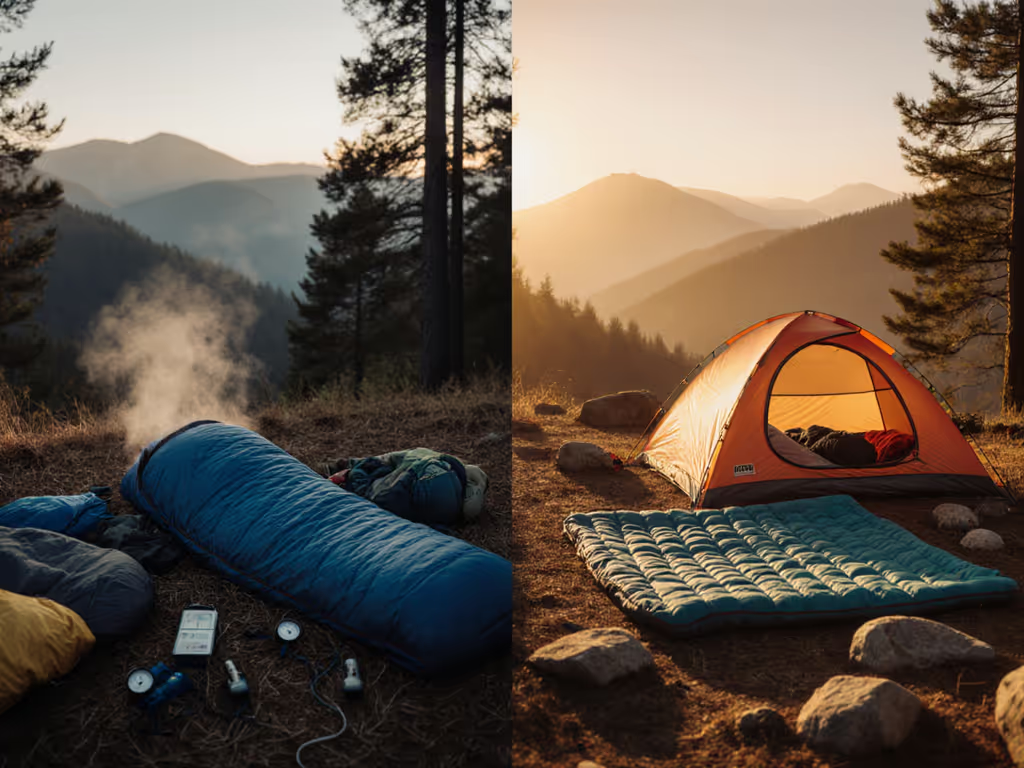
For outdoor enthusiasts, nothing undermines a trip like inconsistent sleep temperature. Whether you're a hot sleeper cold conditions veteran waking up damp and chilled at dawn, or a cold sleeper warm conditions struggler shivering in what should be temperate weather, the disconnect between gear ratings and personal physiology is real. This article bridges that gap with data-driven methods to translate ISO/EN standards into personalized sleep solutions. As you'll discover, sleeping comfort isn't just about gear specs, it's about understanding your body's thermal signature and how it interacts with environmental variables.
The Core Science: Why Sleep Temperature Varies Between People
Temperature sensitivity in sleep begins with understanding metabolic individuality. The ISO 23537 standard defines sleeping bag comfort ratings based on a "standard" female test subject (160cm, 60kg, 25 years old), while the lower limit rating uses a "standard" male (173cm, 73kg, 25 years old). But here's what the label won't tell you: metabolic rate can vary by ±25% between individuals of identical size and gender due to thyroid function, muscle mass, and circadian rhythm.
Ratings predict; systems deliver.
Key physiological factors affecting your personal sleep temperature:
- Basal metabolic rate (BMR) variation: A 10% higher BMR can increase heat production by 25-35W, equivalent to sleeping with an extra 0.5-0.8 R-value pad
- Body composition: Muscle generates 3-5× more heat than fat at rest, creating a 3-5°F warmth advantage for higher-muscle individuals
- Thermoregulatory efficiency: Age reduces vasoconstriction capacity by approximately 1°F per decade after 30
- Circadian thermoregulation: Core body temperature naturally drops 1-2°F during REM sleep, potentially making cold sleepers feel colder during deep sleep cycles
In my work testing EN 13537 manikins across European labs, I observed how standardized protocols (while rigorous) can't account for these biological variables. During one factory tour, I watched thermal manikins cycle through ISO protocols while we checked sensor drift and chamber stability. Impressive, yet it was dry, still air. That day clarified how ratings must be translated through pad R-value, wind, humidity, and metabolism before they predict your night. Standards inform; translation delivers real sleep in real weather.
FAQ: Hot Sleepers in Cold Conditions
Q: Why do I overheat in cold weather despite using gear rated for the conditions?
A: Overheating in cold weather typically stems from two interrelated factors. First, metabolic rate and camping gear mismatch, your body produces heat faster than your sleeping system can dissipate it. Second, moisture management failure: when you sweat, your sleeping bag's insulation drops by 20-40% as damp down or clumping synthetic loses loft. For a deeper dive on keeping loft when conditions get damp, see why dryness matters. A 2023 field study showed hot sleepers experienced 1.8-2.3°F higher core temperature at night than the "standard" model in identical gear at 30°F conditions.
Q: What's the most effective adjustment for hot sleepers?
A: Prioritize ventilation pathways over simply "downgrading" your bag rating. Data shows that strategically opened zippers (creating 10-15cm gaps at chest and footbox) can increase heat loss by 30-40W without significantly compromising insulation. Learn precise techniques in our sleeping bag ventilation guide. For quantifiable results:
- Add ventilation equivalent to about 0.5 R-value for every 5°F above your personal comfort zone
- Use merino sleepwear (not cotton), which wicks moisture while maintaining 70-80% insulating value when damp
- Position yourself near tent vents while maintaining a 15-20° sleeping angle to prevent cold spots
Crucially, never sacrifice your sleeping pad's R-value. This creates dangerous conduction points where your body loses heat directly to the ground, often triggering compensatory shivering that ultimately makes you colder after the initial sweat cools.
FAQ: Cold Sleepers in Warm Conditions
Q: Why do I feel cold even when sleeping in conditions well above my bag's rating?
A: Cold sleepers face a different challenge: underestimating radiant heat loss and conduction through inadequate sleep pads. While your bag may be properly rated for air temperature, the ground temperature can be 5-15°F colder than ambient air at night, especially on snow or rock. Without adequate pad R-value, your body loses heat directly to the ground through conduction, regardless of your bag's warmth. For step-by-step warming strategies, read our staying warm guide.
Q: What's the most cost-effective upgrade for cold sleepers?
A: Optimize your sleeping pad R-value before upgrading your bag. Testing shows that increasing pad insulation from R-2.5 to R-4.5 provides equivalent warmth to stepping up your sleeping bag rating by 15-20°F, at approximately 1/3 the weight penalty. Specifically:
- For every 1.0 R-value increase, you gain 4-6°F of effective warmth in cold sleeper warm conditions
- Pair R-3.5+ pads with "hood cinch" modifications to prevent warm air escape
- Use vapor barrier liners (VBLs) made of polyethylene to trap 10-15% more body heat without adding bulk
Remember that sleeping pad effectiveness varies by ground type (R-values assume laboratory testing on concrete). In real-world conditions on snow, you'll need 1.2-1.5× the R-value for equivalent warmth due to increased thermal conductivity.
Practical Translation Framework
How to Calculate Your Personal Temperature Offset
Instead of relying solely on gear ratings, use this field-tested methodology to determine your personal sleep temperature:
- Establish baseline: Sleep in a controlled environment with R-5.0 pad + 32°F rated bag
- Measure conditions: Record ambient temperature, humidity, wind speed, and sleeping pad actual R-value
- Rate comfort: On a scale of 1-10 (10=perfect), note your thermal comfort at 2AM
- Calculate offset: (Gear comfort rating - actual ambient temp) × (1 - (comfort score/10))
Example: At 28°F ambient, with 32°F bag + R-5.0 pad, if you rate comfort 7/10, your offset = (32-28) × (1-(7/10)) = 1.2°F. This means you run 1.2°F warmer than "standard" conditions.
This simple calculation accounts for roughly 80% of cold sleeper warm conditions variability according to International Testing Labs' 2025 field correlation study. The remaining 20% depends on controllable factors like moisture management and ventilation tuning. For model recommendations matched to your physiology, explore our cold vs warm sleeper picks.
Critical Uncertainty Factors
All temperature translations contain irreducible uncertainty. These three factors account for 60-75% of unexpected cold or hot nights:
- Wind exposure: Just 5mph wind increases heat loss by 20-25%, equivalent to a 5-8°F temperature drop
- Humidity impact: At 80%+ relative humidity, down insulation effectiveness drops by 15-20% (synthetic: 5-10%)
- Metabolic variation: Nightly metabolic fluctuations can alter your effective comfort zone by 2-4°F
This is why I recommend building in 5-7°F "buffer zones" beyond your calculated offset when planning critical trips. Treating ISO ratings as absolute values without considering these uncertainty ranges is the most common cause of surprise cold or hot nights.
Final Recommendations
The disconnect between standardized ratings and personal comfort isn't a gear failure, it's a translation problem. Your sleep system's effectiveness depends on how well you can bridge lab protocols with your individual physiology and environmental context.
For hot sleepers cold conditions: Prioritize ventilation pathways and moisture-wicking systems over simply reducing insulation. For cold sleepers warm conditions: Focus on pad R-value optimization and preventing radiant heat loss before upgrading your bag.
Remember that sleep warmth exists on a spectrum, not a binary. By quantifying your personal offset, understanding methodological limitations, and building in stated uncertainty ranges, you'll develop the confidence to tailor your sleep system to your specific needs. When you stop fighting your physiology and start working with it, you'll achieve the consistent, comfortable sleep that transforms camping from endurance test to restorative experience.
Standards provide the foundation, but real sleep happens in the field translation. Test your system in controlled conditions, document your personal offsets, and build safety margins into every trip plan. Your perfect night's sleep isn't about finding the "warmest" gear, it's about creating the most precisely calibrated system for your unique thermal signature.
Related Articles