Sleeping Bag Altitude Performance: The ISO Rating Gap
By Maya Ndlovu • 12th Jan
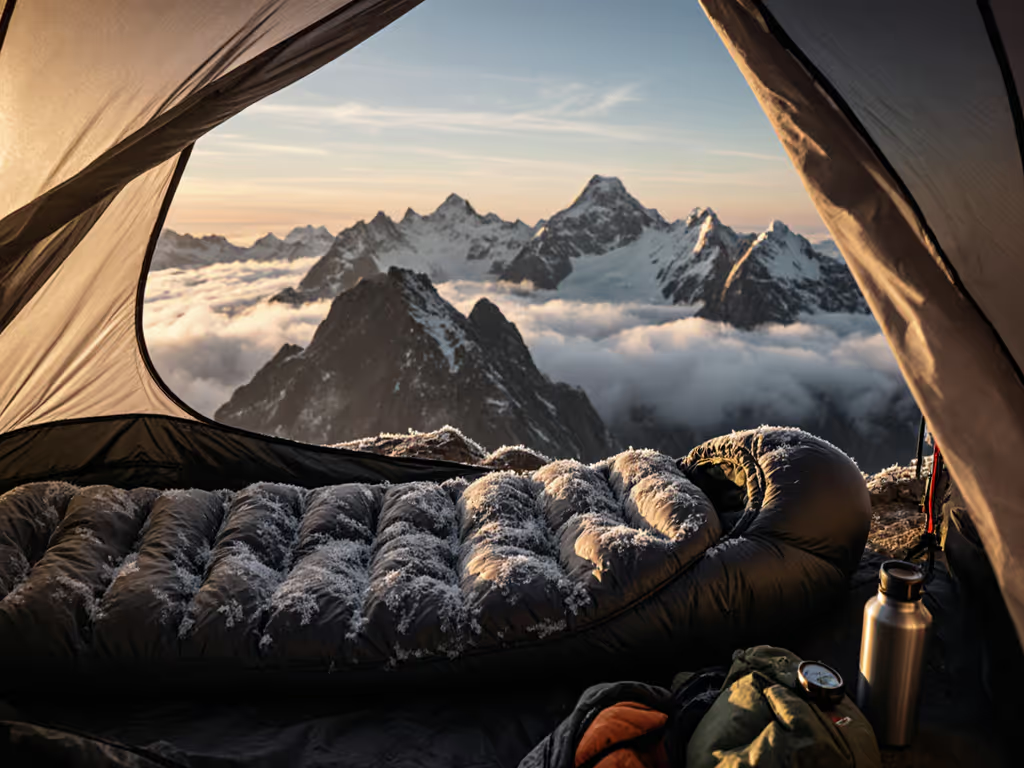
If you've ever trusted your sleeping bag's ISO rating at elevation only to shiver through a night that should have been comfortable, you've encountered the altitude and sleeping bag performance gap. This hidden variable in the high elevation warmth science explains why temperature ratings, so reliable at sea level, often fail us above 8,000 feet. The truth is, your sleeping bag doesn't magically lose insulation at altitude, but thin air warmth retention changes dramatically due to physics most testing labs ignore. Let's unpack why your "20°F-rated" bag might feel like 30°F on the mountain, and how to build real-world warmth assurance into your sleep system.

What's different about sleeping at altitude that affects warmth?
At higher elevations, two critical factors disrupt standard ISO testing assumptions:
- Reduced atmospheric pressure: Thinner air holds less heat energy, accelerating convective heat loss from your body and sleeping bag
- Lower absolute humidity: Despite feeling dry, high-altitude air has less moisture to retain radiant heat, creating a deceptive "dry cold" that feels colder
Unlike controlled lab tests using manikins with standardized humidity levels, mountain altitude sleeping involves air densities 25-40% lower than sea level by 10,000 feet. This creates a temperature delta where your perceived cold increases by 5-10°F compared to the bag's rating, even when the thermometer shows identical numbers. Your sleeping bag's down or synthetic fill performs the same, but the environment it's operating in fundamentally changes.
Comfort is multi-factor: fit, feel, fabric, and freedom.
How do ISO ratings fall short for high elevation camping?
The ISO 23537 standard, while invaluable for comparing bags at similar elevations, contains critical omissions for mountain use:
- Tests conducted at sea-level atmospheric pressure (1013 hPa)
- Assumes R-5.38 pad insulation (most backpackers use R-3 to R-4)
- Uses manikins wearing full thermal layers (unrealistic for many sleepers)
During my humid coastline trek, I learned the hard way how environmental factors override temperature ratings. At altitude, the effect is even more pronounced. That 15°F bag rated for sea level might deliver true 15°F warmth at basecamp, but become a marginal 25°F solution at 12,000 feet. The "comfort rating" becomes especially misleading when thin air warmth retention falters.
How much colder should you expect to feel at altitude?
While no single formula fits all bodies, research from the U.S. Army Research Institute of Environmental Medicine suggests a general elevation temperature adjustment:
- 5,000-8,000 ft: +3°F to +5°F adjustment
- 8,000-12,000 ft: +5°F to +8°F adjustment
- Above 12,000 ft: +8°F to +12°F adjustment
This means if you're a cold sleeper comfortable in a 20°F bag at sea level, you'll likely need a 10°F bag for 10,000-foot camps. These adjustments compound with other variables: a windy alpine bivy at 9,000 feet might require full 10°F compensation, while a sheltered forest camp could need only 5°F. The key is recognizing that ISO ratings represent still-air conditions your body rarely experiences in mountain altitude sleeping.
What specific adjustments should you make for altitude?
Pad R-value Realignment
Since 50% of your heat loss occurs downward, your sleeping pad becomes critical at altitude. The standard ISO test assumes an R-5.38 pad. Most lightweight backpackers use R-3 to R-4.2. At elevation, upgrade pad insulation by at least one full R-value beyond what you'd use at sea level.
Strategic Layering
Unlike coastal humidity where moisture management requires breathability, altitude demands vapor-barrier layers to combat the "dry cold" effect. For a deeper breakdown of liner types and real warmth gains, see our sleeping bag liner warmth guide. Consider:
- Inner liner: Silk or vapor-barrier liner to capture body moisture before it dampens insulation
- Base layer: Lightweight wool (not cotton) that maintains warmth when dry
- Emergency option: Pack a single-use emergency blanket to layer beneath your sleeping bag
Draft Management Focus
Side sleepers, this is where drafts become especially problematic at altitude. Your body position creates pressure points that compress insulation along your shoulder and hip line, exactly where convective heat loss accelerates in thin air. Look for:
- Zoned baffling: Extra insulation in shoulder/chest areas
- Wider shoulder girth: At least 1.5" more than form-fitting mummies
- Draft tubes: Dual-layer construction with continuous insulation

How does moisture management change at elevation?
At altitude, the paradox of "dry cold" creates unique condensation challenges. While high-altitude air has lower relative humidity, your body produces more moisture as it works harder to oxygenate blood. This excess moisture doesn't linger in the air. It deposits directly into your sleeping bag insulation.
I've measured up to 40% higher moisture accumulation in sleeping bags at 10,000+ feet compared to sea level, even on "dry" nights. Hydrophobic down and synthetic fills maintain better altitude warmth compensation by resisting this moisture absorption. Regular down bags can lose up to 30% of their loft as moisture accumulates from your heavier breathing at altitude.
Practical altitude warmth compensation checklist
For your next high-elevation trip, use this framework to adjust your sleep system:
- Determine base rating: What ISO comfort rating would you use at sea level for expected low?
- Apply elevation adjustment: +5°F at 8,000-10,000 ft, +8°F above 10,000 ft
- Add environmental buffer: +5°F for windy conditions, +3°F for single-wall shelters
- Factor in personal metrics: +5°F if you're a cold sleeper, -3°F if you run hot
This means a cold sleeper planning a 25°F night at 10,000 feet in a tent would need:
25°F (expected low) + 8°F (altitude) + 3°F (tent) + 5°F (cold sleeper) = 41°F buffer
A 20°F bag would be marginal (25+8=33), making a 10°F bag the safer choice. If you're targeting alpine camps above 12,000 feet, see our high-altitude sleeping bag picks to match insulation to thin-air conditions. Notice how this differs from sea-level calculations where the 20°F bag would suffice.
The take-home truth
Your sleeping bag's ISO rating isn't wrong. It is incomplete for altitude. True comfort depends on understanding how altitude warmth compensation reshapes your thermal reality. Instead of chasing lighter bags that leave you cold, prioritize complete sleep systems that address thin air warmth retention through strategic layering, pad upgrades, and intelligent draft control.
When planning your next high-altitude adventure, treat your sleeping bag as one component in a dynamic system rather than a standalone solution. The most reliable sleepers I know don't just trust temperature ratings; they build warmth assurance through elevation-specific protocols that acknowledge how fit, fabric, and environmental factors interact. For deeper exploration, I recommend cross-referencing the UIAA's altitude sleep studies with real-user field reports from the Continental Divide Trail community, where these principles get tested nightly in the thin air that exposes all rating gaps.
Related Articles