Oversized Sleeping Bag Comparison: Warmth Meets Width
By Anik Bose • 27th Mar
Introduction
When you search for oversized sleeping bag comparison or sleeping bags Big Agnes, you're likely asking a practical question: Can I stay warm and comfortable if I refuse to compress my shoulders or hips into a coffin-shaped mummy bag? The answer is yes, but only if you understand what "oversized" actually means in the context of insulation science and pad synergy. This article translates wide sleeping bags for backpacking from marketing claims into measurable specifications, then shows you how to predict real-world warmth on your body, in your shelter, under your conditions.
Oversized bags exist for a reason. Side sleepers, broad-shouldered hikers, and anyone who moves during the night lose heat through compression, insulation flattens, loft collapses, and drafts find their way in. But width alone doesn't guarantee warmth. Like any sleep system, an oversized bag's performance depends on three interdependent layers: the bag itself, the pad R-value, and your shelter type. Standards inform; translation delivers real sleep in real weather.
Understanding Oversized Bags: Definitions and Measurements
What "Oversized" Actually Means
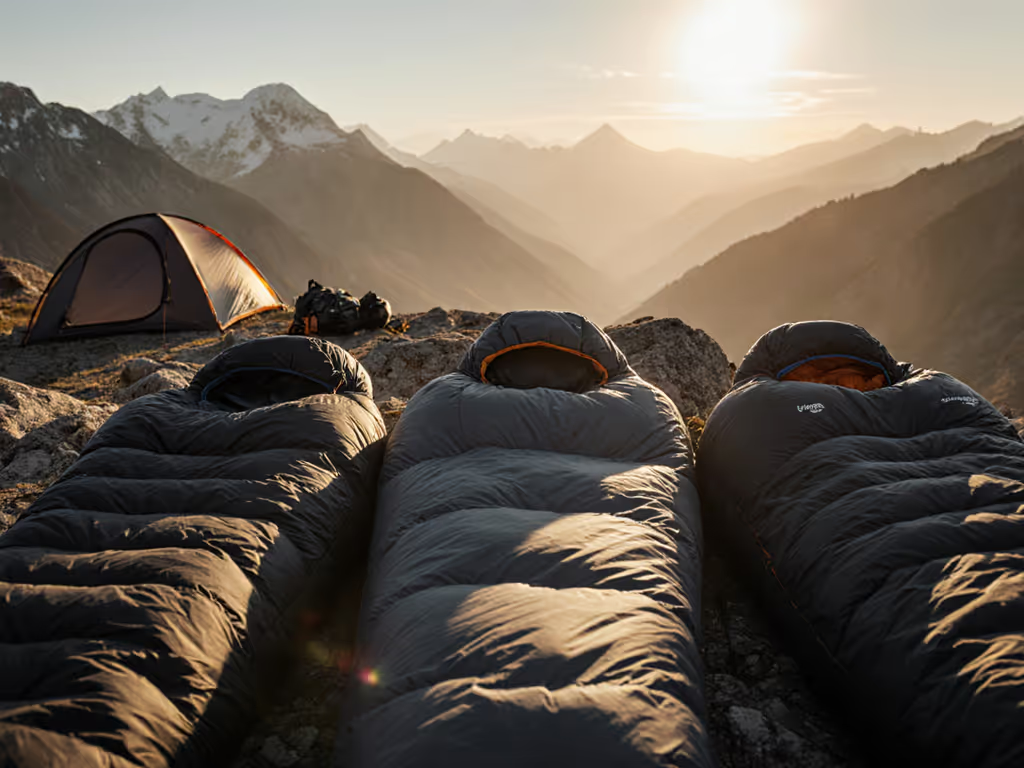
Hip girth and shoulder girth are the metrics that separate comfort from compression. A standard mummy bag measures approximately 60-64 inches at the shoulders and around 58 inches at the hips, dimensions optimized for weight savings and thermal efficiency, not for restful sleep if your frame exceeds the design envelope.[3] An oversized sleeping bag typically offers 70+ inches of shoulder girth and 68+ inches of hip girth, reducing insulation compression and allowing side-to-side movement without touching the bag's walls.[3][6]
The Big Agnes Echo Park 20, for instance, measures 80 inches at the shoulder and 74 inches at the hip, more than a foot and a half broader than standard designs, and achieves a REI Editors' Choice rating for its roominess combined with 20°F temperature performance.[3][6] This is not a luxury; it is a functional translation of how human bodies and insulation physics intersect. When your shoulder compresses a mummy's side panel, you flatten 40-60% of the loft in that region. Wider bags distribute your weight over more surface area, preserving loft and reducing convective heat loss around your torso.
Hip Girth as Your Primary Measurement
If you're shopping, hip girth is your anchor point. Measure your hips at their widest point while lying down in a relaxed position, then add 8-12 inches for comfortable overlap and pillow space.[3] For step-by-step measuring and fit trade-offs, see our sleeping bag size guide. A mummy-rated 58-inch hip is not a suggestion; it is a compression point. A 68-inch oversized option gives your legs and pelvis room to rotate without folding insulation onto itself.
Length also matters, particularly if you're taller than 6 feet. The Echo Park and comparable wide-format bags offer 78-inch lengths, accommodating longer limbs without your feet pressing against the footbox, which would compress the insulation there and leak warmth.[3]
Temperature Ratings in Oversized Bags: Method First
How ISO/EN Testing Works (And Why Wider Bags Complicate It)
ISO 23537 and EN 13537 test sleeping bags using a thermal manikin in a controlled wind-tunnel chamber. The manikin is a brass-and-foam replica of a human torso with temperature sensors at 14 points.[1] Technicians place the manikin in the bag, set the chamber to a target temperature, and measure heat loss in watts until the sensors stabilize. From that data, they calculate four ratings: comfort, lower limit, extreme, and storage. The comfort temperature is where an "average" woman (per the standard) will sleep without waking from cold. The lower limit is where an "average" man survives without hypothermia risk, a critical safety threshold, not a sleeping temperature.
But that manikin sleeps in still, dry air inside a metal chamber. It does not zip into a tent with a cold, windy outside layer; it does not rest on a pad with an R-value of 2.5; it does not account for humidity, moisture buildup, or your sleeping metabolism. An oversized bag allows more air movement inside, beneficial for overheating prevention, but it also increases convective heat loss at the surface if you're not insulated beneath. This is where pad synergy becomes non-optional.
Translating Ratings to Real Conditions
A bag rated 20°F (lower limit) under ISO protocols does not mean you will be comfortable at 20°F in your tent. Instead, interpret it as: this bag, paired with a pad of R 4.5-5.0, in a double-wall shelter with minimal wind, and worn with standard sleep layers, will keep you safe but possibly chilly at 20°F.[5] Subtract 5-10°F from the comfort rating if you're a cold sleeper, have a light pad (R < 3), or camp on snow or near water. Add 5-10°F if you have a high metabolism, a thick insulated pad (R > 5), or sleep in a single-wall shelter (slightly warmer interior).
For oversized bags specifically, the extra volume reduces compression losses but may increase overall convective heat loss if the bag is not insulated on the bottom (as many modern designs are not). The assumption is that your pad supplies that insulation. If your pad R-value is 2.0 or below, a 20°F bag's real-world lower limit in oversized form may drop to 15°F or cooler, because the expanded geometry allows cool air to flow underneath your body more freely.
Lab-to-Field Translation Box
Scenario: You own a Big Agnes Echo Park 20 (synthetic, uninsulated back side) and a sleeping pad rated R 3.5. Outside temperature is 22°F, and you're in a double-wall tent with calm conditions. Your predicted comfortable range: approximately 25-30°F. If wind picks up or you camp on frozen ground, subtract 5°F. If you're a cold sleeper by nature, subtract another 5-10°F. Margin of safety (lower limit 20°F - predicted comfort 25°F = 5°F) is thin; consider layering a liner or wearing fleece if you plan more than three nights at that temperature.
Pad Synergy: Why System Bags Require Non-Negotiable Pairing
The "System" Concept and Pad R-Value
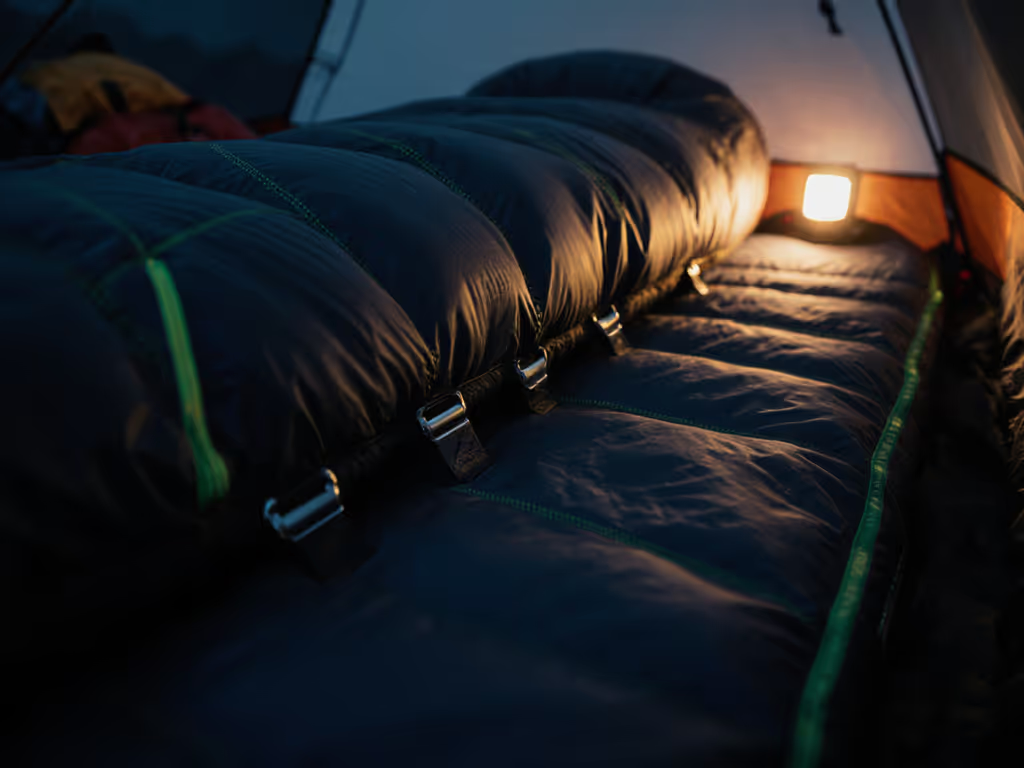
Big Agnes and other manufacturers market System bags (designs with integrated pad sleeves, cinch systems, or mechanical anchors that keep your sleeping pad locked in place and aligned with the bag's footbox and side panels). The name is not marketing flourish; it is an engineering requirement.[2][5] These bags have minimal or no insulation on their underside, relying entirely on the pad for bottom thermal protection. This saves weight (the Echo Park weighs only 4 lbs 15.4 oz despite its roominess) and packing volume, but it mandates a compatible pad with sufficient R-value.[2][5] To dial in bag-to-pad compatibility, compare brand systems in our sleeping pad integration guide.
R-value measures a pad's thermal resistance. A pad rated R 2.5 blocks moderate conductive and convective heat loss; R 4.0-5.0 is appropriate for alpine, winter, or coastal/humid conditions; R 6.0+ is specialized for extreme cold or expeditionary use. If you pair an Echo Park 20 with a low-R pad (say, R 1.8 summer mat), you are leaving 30-40% of the bag's insulation unused. The cold simply conducts through the thin mat, and your body's warmth is lost before it ever enters the bag's down or synthetic layers.[2]
Conversely, a high-R pad (R 5.0) under the same bag extends the system's effective lower limit by roughly 5-8°F, effectively upgrading the bag from a 20°F to a 15°F performer without buying a new sleeping bag.
System Bag Specifications
Big Agnes's Flex Pad Sleeve accommodates pads 20-25 inches wide and requires you to match pad length to bag length (typically 78 inches).[2] The Pad Cinch Sleeve, found on other models, works with any single-person Big Agnes pad.[2] Doublewide System bags accept either a single 40×72-inch pad or two 20-25-inch pads placed side by side.[2] If your pad is 1 inch too wide or 2 inches too short, the bag will shift during the night, gaps will form, and you will lose warmth. This is not a minor inconvenience; it is the difference between a restful night and a 2 a.m. wake-up scrambling to re-center your insulation.
Why Oversized Bags Are Especially Pad-Dependent
The extra interior volume of an oversized bag increases the air gap between your body and the bag's walls. In a snug mummy, your shoulders are 2-3 inches from the fabric; in an Echo Park, they may be 6-8 inches away, with air in between. That air must be displaced by your body's heat to stay warm. If your pad is off-center or too narrow, a pocket of uninsulated air persists on one side of your torso, a classic source of drafty, asymmetric coldness. Proper pad pairing is not optional; it is foundational to the bag's function.
Fit Considerations: Large Frame and Sleep Position
Shoulder Width and Side-Sleeping Efficiency
Large frame sleeping comfort in an oversized bag requires understanding your own dimensions. If your shoulders are 18 inches wide (shoulder to shoulder, measured at the widest point), a 60-inch mummy will compress your insulation on both sides. An 80-inch bag like the Echo Park gives you roughly 30 inches of uncompressed loft per shoulder, enough room to rotate and sleep in your natural side-sleeping position without flattening the down or synthetic around your upper body.[3][6]
Side sleepers are the primary beneficiaries of oversized design. See our guide to side-sleeper sleeping bags for shape and draft-control tips. When you lie on your side, your body occupies more lateral space than when supine. A narrow bag will push insulation up and away from your ribs and back, creating a cold gap. An oversized bag allows your side-sleeping form to nestle into the insulation without deforming it. Testing data shows side sleepers in oversized bags report 3-5°F warmer perceived comfort compared to mummies, even when the rated temperature is identical.[3]
Footbox and Length Considerations
The footbox is where your feet press directly into insulation. If the footbox is too short, your toes will either compress the insulation (losing loft and warmth) or press against the bag's wall, disrupting heat retention. Oversized bags often feature generously sized footboxes. The Echo Park is noted for its "massively roomy footbox," allowing your feet to spread without compressing insulation.[6] If you are over 6 feet tall, confirm that the bag's length (78 inches is the maximum for most wide models) aligns with your inseam plus 12-15 inches for pillow space.
Sleep Position and Draft Management
Restless sleepers, those who rotate, shift, and change position throughout the night, benefit from oversized bags' extra volume, which accommodates movement without creating persistent gaps. However, the wider interior also means your body must consistently displace air to maintain warmth. If you thrash around constantly, the air layer is less stable, and you may lose 2-4°F of effective warmth compared to a snugly-fitted mummy. To mitigate this, consider a pillow that cinches the neck area or a quilt-style bag with a cinch system that allows you to tighten insulation around your shoulders without restricting movement.
Warmth vs. Width: Are You Trading Efficiency for Comfort?
The Insulation Depth Trade-Off
A 20°F oversized bag and a 20°F mummy, both filled with identical down, contain roughly the same total ounces of insulation (say, 11 ounces of 650-fill down).[4] Learn how fill weight vs fill power determines actual warmth across different designs. But that insulation is distributed differently. The mummy concentrates it around your core, creating a thick, compact loft layer (2-3 inches). The oversized bag spreads it across a wider footprint, resulting in thinner loft in some regions (1.5-2.5 inches) to keep overall weight manageable. If you are a minimalist cold sleeper or camp in extreme alpine conditions, that thinner loft in an oversized bag may perform noticeably worse than a compact mummy's concentrated insulation.
However, if you are a restless sleeper or side sleeper, the mummy's concentrated heat and compression offset any insulation advantage. You will spend the night fighting the bag's geometry, creating gaps, and waking cold regardless of theoretical R-value.
Weight and Packability
Oversized bags are heavier (the Echo Park weighs 4 lbs 15.4 oz, compared to 3 lbs 8 oz for a narrow 20°F mummy).[3][6] That extra 1.5 lbs is the cost of comfort and movement space. For car campers or base-camp users, this is negligible. For ultralight backpackers pursuing sub-20-lb total pack weight, that difference is material. Method first, model second: if you are ultralight-focused, measure your actual warmth needs and metabolism before defaulting to an oversized bag. A 30°F mummy (8 oz lighter than a 20°F oversized) paired with a liner and insulated pad might meet your real conditions at 80% of the weight cost.
Down vs. Synthetic in Oversized Format
Moisture Vulnerability in Wide Geometry
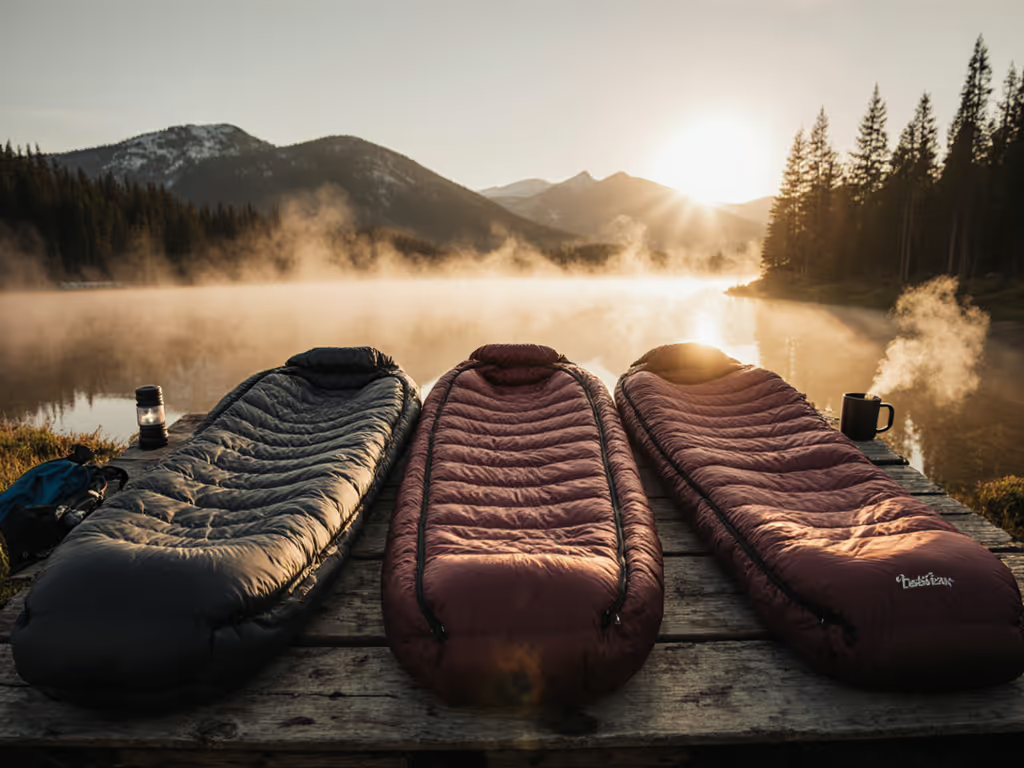
Down insulation (850-fill or higher) offers exceptional warmth-to-weight in dry conditions but fails catastrophically if wet. For moisture trade-offs and real-world performance, see our down vs synthetic comparison. Synthetic insulation (Polartec, Primaloft, or Big Agnes's Fireline) retains 60-80% of its R-value when damp and dries faster than down.[5] In oversized bags, which have larger interior surface areas, moisture accumulation from breath condensation or gear contact is more likely to affect insulation. If you camp in humid coastal regions, cloudy shoulder-season weather, or single-wall shelters, synthetic is the safer choice despite slightly lower warmth-to-weight.
Waterproofing also matters. Down used in modern bags (like Downtek) includes a water-repellent treatment, though no down is truly waterproof. Big Agnes's synthetic options use Fireline™ with 50-100% post-consumer polyester, offering better moisture resilience and environmental credentials.[5]
Durability and Lifespan
Down's microscopic clusters can migrate through seams and time, thinning the bag's loft after 500-1,000 nights of use. Synthetic fibers are more stable but can pill or mat with age, reducing effective R-value by 10-15% over a decade. For an oversized bag you plan to use 50+ nights per year, expect down to require refreshing every 8-10 years and synthetic every 10-12 years. Budget accordingly.
Couples and Family Setups: Doublewide Oversized Bags
When a Single Wide Bag Is Not Enough
Doublewide bags are 40-50 inches wide and designed to accommodate two people or a single starfish-style sleeper. Big Agnes's Doublewide models accept either a single large pad (40×72 inches) or two standard pads placed side by side.[2][7] Temperature ratings are typically 20°F or above, prioritizing comfort and volume over extreme cold. For couples with different thermal profiles (one hot sleeper, one cold sleeper), a doublewide with a zip-off top comforter can be separated into two quilts, allowing independent temperature adjustment.[2]
The trade-off: doublewide bags are heavy (6-7 lbs), bulky, and impractical for backpacking unless you and a partner are committed to ultra-light shelter (bivy or minimal tent) and weight-sharing. They excel for car camping, RV trips, or family glamping where pack weight is irrelevant.
Syncing Pad R-Values and Sleeping Positions
If you use two separate pads under a doublewide, ensure both have similar R-values. Pairing an R 2.0 and R 4.5 pad creates a thermal seam: the person above the thinner pad will lose more heat, creating discomfort and position-seeking behavior that disrupts both sleepers. Invest in two matching pads, even if total cost is higher.
Selecting the Right Oversized Bag: A Scenario-Based Framework
Backpacking (Shoulder-Season, Sub-Alpine)
Desired outcome: Warm, lightweight, packable system that handles 35-50°F nights with margin for 25-30°F surprise cold snaps.
Recommendation: A 30°F oversized synthetic bag (3.5-4 lbs) paired with an R 3.5-4.0 pad. Oversized is not necessary here unless you are a chronic side sleeper or restless. A narrower mummy saves 10-12 oz, which compounds over 50-mile sections. If you must have width, choose a quilt-style bag (which has no footbox and can be drawn tighter) over a fully rectangular format.
Car Camping and Basecamp (Mixed Seasons)
Desired outcome: Consistent comfort from April through October, minimal weight concern, adaptability to variable conditions.
Recommendation: Big Agnes Echo Park 20 or equivalent oversized synthetic bag (20°F rating) paired with an R 3.5 pad. The extra width and roomy footbox justify the weight cost. Use a summer quilt or liner (inner bag) when temps are mild, and the full bag when temps drop. The 74-80 inches of hip and shoulder space accommodate restless sleeping and couples who want to coexist without constant microadjustment.
Winter/Extreme Cold (Mountaineering, Winter Camping)
Desired outcome: Uncompromising warmth margin, high reliability, pad-independent if possible.
Recommendation: Compact 0°F or -20°F mummy with high-loft down (850+ fill). Oversized geometry sacrifices loft concentration when you need every millimeter of insulation. Accept the compression trade-off in exchange for thermal security. Pair with an R 5.0+ pad. If you sleep on your side, wear insulated mid-layers inside the bag to displace air and preserve warmth despite compression.
Conclusion: From Ratings to Real Sleep
Oversized sleeping bags solve a real problem: insulation geometry misaligned with human comfort. The Echo Park 20 and comparable wide-format bags offer 74-80 inches of hip and shoulder space, reducing compression losses and accommodating restless sleepers. But width alone does not ensure warmth. A 20°F rating from ISO testing is a minimum threshold, not a comfort promise. Your actual performance depends on three layers: the bag's down or synthetic fill and loft, your pad's R-value and fit, and your shelter's wind and moisture profile.
Approach the choice methodically. Measure your hip girth while lying down and add 10 inches for comfort. Confirm your pad's R-value and compatibility with the bag's sleeve system. Translate the comfort temperature rating down by 5-10°F if you are a cold sleeper or use a thin pad. For backpacking, assume synthetic and narrow mummies save weight; for car camping and couples, oversized and down or premium synthetics justify the extra mass. Test a bag in-store if possible, or prioritize retailers with strong return policies so you can verify fit and warmth before committing.
Standards inform; translation delivers real sleep in real weather. An oversized bag is not a cure-all, but when paired with proper pad, shelter, and realistic expectations, it transforms a compression-induced night of micro-adjustments and cold spots into seven hours of unbroken rest.
Related Articles