Sleeping Bag Baffle Designs Explained For Real-World Warmth
By Diego Martins • 25th May

If you've ever woken up shivering in a "correctly rated" bag, this is probably the article you wish you'd read first. Here are sleeping bag baffle designs explained in plain language, with a focus on baffle construction warmth efficiency (how different baffle choices actually translate to warmth, weight, durability, and cost-per-night in the field).
I learned the hard way on a shoulder-season desert loop: great forecast, bargain bag, low-R pad, clear sky, long night. On paper, the temperature rating penciled out; in reality, the baffle layout, compressed insulation, and convective heat loss turned it into a shaky dawn. That's when I started treating baffle design as part of a system, not a footnote.
Price-to-warmth matters, but failure costs the most outdoors.
What Baffles Actually Do (And Why You Get Cold Spots)
A baffle is the fabric wall that separates the inner and outer shells of a sleeping bag and holds insulation in place. Without baffles, down or synthetic fill would clump, slide, and leave bald patches; with poorly designed baffles, you get thin areas and "cold lines" where heat escapes.
Good baffle design solves three problems:
- Insulation distribution - keeping the right amount of fill over high-loss zones like your chest and hips.
- Loft preservation - allowing insulation to fully loft instead of getting pinched flat along seams.
- Draft and convection control - minimizing internal air currents so your body isn't constantly reheating moving air.
Lab tests like EN/ISO ratings assume the insulation is perfectly distributed and fully lofted. To understand how lab ratings translate outside the test mannequin, read our EN/ISO ratings decoded guide. In the real world, bad baffle layout, poor fit, or shifted down mean your "20°F" bag can feel like a 30°F quilt with gaps.

Think of baffles as the internal architecture of your bag: you rarely see them, but they decide whether that expensive down is working for you or just riding along as useless weight.
Sewn-Through Baffles: Ultralight With Built-In Cold Lines
Sewn-through construction is the simplest: the inner and outer shells are stitched directly together, pinching the insulation at every seam. There are no sidewalls between the shells.
Pros:
- Very light and packable.
- Cheaper to manufacture, so usually lower sticker price.
- Fewer internal pieces; simpler to repair if a seam fails.
Cons:
- Wherever the seam runs, the insulation is compressed to almost zero, creating thermal bridges (visible lines where heat leaks out).
- At lower temperatures, those lines become very obvious cold spots, especially in wind or if your shelter has more convection.
For most people, sewn-through bags are best kept to warm-weather use (roughly 40°F / 5°C and up) or as part of a layered system. If you're shopping for hot-weather trips, see our best summer sleeping bags guide. If you're a cold sleeper, in a drafty shelter, or pushing shoulder seasons, sewn-through across the torso is a red risk flag.
From a cost-per-night standpoint, sewn-through construction looks attractive on the shelf: low price, low weight. But once you start stacking in extra layers to compensate (or retiring the bag early because you're always chilly), the value erodes fast.
Box-Wall Baffles: Baseline For True Three-Season Warmth
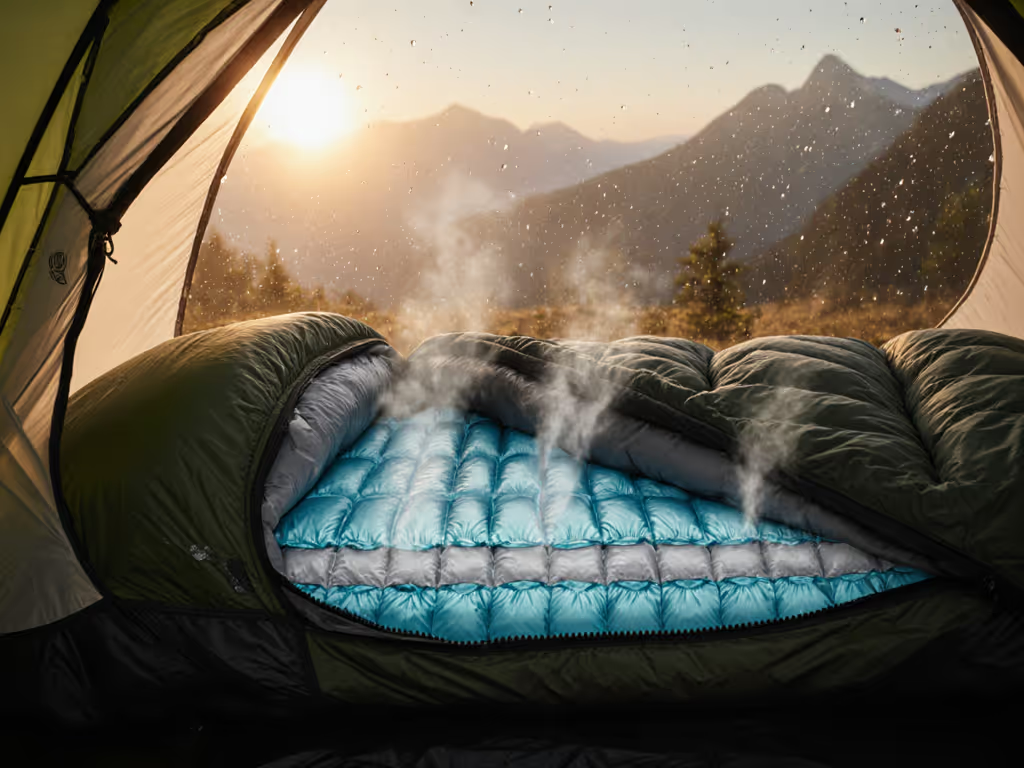
Box-wall baffles add fabric walls between inner and outer shells, creating rectangular chambers so insulation can loft to its full thickness without getting pinched at seams. This is often called box-wall vs sewn-through baffles in spec sheets.
Advantages:
- Significantly warmer for the same fill weight because loft is preserved across the entire panel.
- Far fewer pronounced cold lines; heat flow through the bag becomes more uniform.
- Better control of sleeping bag insulation distribution; manufacturers can place more fill where you need it, like over the chest and feet.
Trade-offs:
- More fabric and stitching mean more weight and higher cost.
- Slightly more complex to repair if an internal wall tears, but failures are rare in quality bags.
For baffle construction for cold weather, box-wall is the minimum I'd consider for a bag you rely on below freezing. To choose the right rating alongside better construction, see our winter bag ratings field test: 0°F vs 20°F. Many reputable brands use box-wall baffles in their 3-season and winter lines because the warmth efficiency per ounce is so much higher than sewn-through.
If you're evaluating a bag in the 15-35°F (-9 to 2°C) range and see sewn-through baffles over the torso, that's a yellow-to-red flag for real-world warmth.
Trapezoidal, Offset, and Fancy Baffles: Squeezing More Warmth From the Same Down
Once you get past simple rectangles, brands start playing with shapes to improve baffle construction warmth efficiency.
Trapezoidal Baffles
Trapezoidal baffles use angled sidewalls instead of simple rectangles. The goal is to reduce thin spots and make the insulation layer more continuous, especially when the bag is wrapped around a curved body.
Trapezoidal baffle advantages:
- Less chance of cold spots along seams because adjacent chambers overlap coverage.
- Better stability of down: it's less likely to migrate into clumps or corners.
- Slight thermal gain vs box-wall at similar fill weight, especially in torso areas.
These show up most often in colder-rated bags where a few percent improvement in efficiency matters.
Offset Baffles
Offset baffle construction staggers the inner and outer seams so they don't line up, eliminating direct stitch-through paths for heat loss.
- Imagine brickwork: each seam is covered by an insulation chamber on the opposite side.
- This design notably reduces thermal bridges, especially important in sub-freezing bags.
Offset trapezoidal or offset box baffles are commonly used in serious cold weather bags where every leak point matters.
Is It Worth Paying For These?
From a pure cost-per-night view:
- For summer-only users, probably not.
- For true 3-season and mild winter use, trapezoidal/offset designs can let you carry a slightly lighter bag for the same real-world warmth, or enjoy extra safety margin at the same fill weight.
- If you routinely sleep near the edge of your rating, these designs are a green flag.
Spend where failure hurts; save where you can on the rest. For many cold sleepers, that means paying up once for a well-baffled primary bag instead of cycling through two or three "good deals" that never feel quite warm enough.
Baffle Orientation: Horizontal, Vertical, Chevron, Hybrid
So far we've looked at cross-section shape. But orientation (how those chambers run around your body) also affects warmth and comfort.
Horizontal Baffles
Horizontal baffles run around the circumference of the bag (like rings).
Pros:
- Let you shift down where you want it; many people push more fill toward the torso on colder nights.
- Conform well for a variety of sleep positions.
Cons:
- That same mobility can let down migrate away from high-pressure areas over time, especially for restless sleepers.
- If a horizontal baffle is underfilled, you may see down pooling at the sides and thin spots on top.
Horizontal layouts are flexible and common; they're especially nice if your trips span a wide temperature range and you like the option to adjust distribution.
Vertical / Side-Block Baffles
Vertical or "side-block" baffles run head-to-toe, often concentrated over the torso.
Pros:
- Great for restless or side sleepers who fight down migration; the fill tends to stay put over your core.
- Good at controlling drafts along the zipper side when paired with draft tubes.
Cons:
- Less ability to intentionally move down around.
- Slightly more complex patterning, so usually found on mid- to high-end bags.
Many high-performance bags use a hybrid: vertical baffles over the torso for stability, horizontal or slanted baffles elsewhere for comfort and adjustability. If you sleep on your side, our side sleeper sleeping bags guide explains which shapes and dimensions stay warm without squeezing shoulders.
Chevron, V, and Boxy Hybrids
Chevron or V-shaped baffles and more complex quilting patterns aim to:
- Reduce large migration paths.
- Improve wrap around the body.
- Break up long seam lines that can become cold zones.
These can be helpful, but don't let a fancy pattern distract you from basics: fill weight, box/offset construction, and pad R-value still drive 90% of your warmth.
How Baffle Choices Show Up At 3 A.M.
Here's how all this plays out when the thermometer drops.
- A sewn-through, horizontal-baffle bag at its rating on a low-R pad in a breezy tent: cold lines along every stitch, down slumped off your shoulders, and constant reheating of moving air as drafts sneak in.
- A box-wall, vertical-torso-baffle bag with offset seams, matched to an appropriate R-value pad and decent tent: more even loft over your core, fewer thermal bridges, and a much closer match between lab rating and lived experience.
Because EN/ISO tests don't fully account for baffle orientation or down shift, two "20°F" bags can feel radically different if one uses simple sewn-through tubes and the other uses well-executed box/offset construction.
Simple Temperature Heuristics (Assuming Good Fit & Pad)
These are conservative rules of thumb, not absolutes:
-
>40°F / 5°C (warm-weather)
-
Sewn-through acceptable for most.
-
Cold sleepers: consider light box-wall over torso.
-
40-25°F / 5 to -4°C (true 3-season)
-
Prefer full box-wall over the torso and feet.
-
Avoid fully sewn-through designs around the chest for cold sleepers.
-
<25°F / -4°C (shoulder-season and winter)
-
Look for box-wall or trapezoidal + offset baffles, especially over the torso and hood.
-
Vertical or hybrid baffle orientation to control migration is a plus.
If you routinely pull long days or guide others, err on the warm, well-baffled side. It's cheaper than underperforming for the last half of every trip.
Durability, Repairability, and Value Over Seasons
From a repair vs replace perspective:
-
Sewn-through bags
-
Pros: Fewer internal parts; seam failures are straightforward to patch.
-
Cons: More seams overall mean more potential weak points, and thinner shells are common in this category.
-
Box-wall / trapezoidal / offset bags
-
Pros: Typically built for harsher use; often heavier fabrics and higher-quality stitching.
-
Cons: Internal baffle wall tears are harder to fix, but rare if you treat the bag decently.
On cost-per-night math, a well-built box-wall bag that genuinely serves you for 8-10 seasons usually beats a cheaper sewn-through bag you only trust for half your trips. Buying used from reputable brands with solid baffle construction is often a smarter move than buying a brand-new, bargain-bin design that leans on optimistic ratings.
Final Verdict: Matching Baffle Design To Your Use
To wrap up the sleeping bag baffle designs explained story into actionable choices:
- If you mostly camp in mild summer conditions, a quality sewn-through bag can be fine (just don't expect it to do 3-season duty without extra layers).
- For most backpackers and shoulder-season car campers, a box-wall bag with sensible baffle orientation (often hybrid: vertical torso, horizontal elsewhere) is the practical sweet spot for baffle construction warmth efficiency.
- If you are a cold sleeper, camp in exposed or alpine sites, or regularly sleep near freezing or below, prioritize:
- Box-wall or trapezoidal chambers with offset seams.
- Stable torso baffles (vertical or hybrid) to prevent down migration.
- Enough fill and pad R-value to give you a safety buffer.
Treat baffle design as a core spec, not a marketing afterthought. When you're comparing bags in your spreadsheet, add columns for construction type (sewn-through vs box-wall vs trapezoidal/offset) and baffle orientation (horizontal/vertical/hybrid), then weigh them against your real temperatures, pad, shelter, and how cold you typically sleep. To compare insulation apples-to-apples, use our fill weight vs fill power guide for realistic warmth comparisons.
You don't need the fanciest pattern on the market; you need the simplest baffle layout that reliably keeps loft where your body loses heat, night after night. That is where value lives, and where you stop gambling on sleep.
Related Articles