
SynergyLink Connectors: Do They Really Prevent Cold Spots?
By Anik Bose • 6th May
Introduction
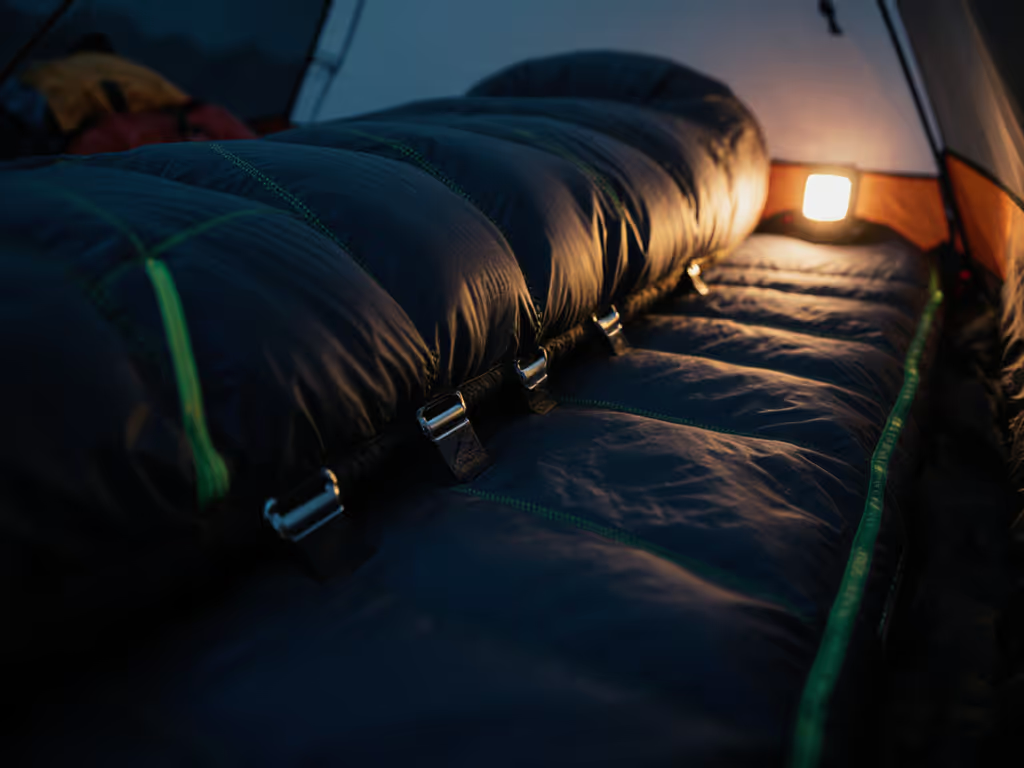
SynergyLink connector sleeping bags and similar fastening systems have emerged as a response to a problem that many backcountry sleepers face: gaps, slippage, and temperature variance across the torso and limbs during the night. The premise is straightforward: connectors lock the bag to the pad, reducing movement and the drafts that follow. But before investing in a connector-equipped system, it is worth asking whether the technology actually closes cold spots or merely promises what good fit and adequate insulation should already deliver.
The question is not rhetorical. Therm-a-Rest connector technology and its competitors operate within a real thermodynamic context, yet marketing claims often gloss over the translation from lab certification to field reality. This deep dive separates ISO/EN laboratory conditions from the dynamic conditions you will face, and measures the connector's actual contribution to sleep quality and warmth.
How Do Sleeping Bag Connectors Work (and What Problem Are They Solving?)
Before evaluating connectors, define the problem they address. A connector is typically a mechanical attachment point (a clip, loop, or integrated pocket) that anchors the sleeping bag to the sleeping pad's perimeter or underside. The intent is threefold:
- Reduce internal movement of the insulation layer relative to your body and the pad beneath.
- Minimize drafts caused by your torso shifting away from the bag's sidewalls.
- Prevent pad slippage, which can create voids where body heat radiates away to bare ground or condensation accumulates.
These are legitimate concerns. A sleeping bag, by definition, is a thermal shell rated under static conditions. The ISO 23537 standard (formerly EN 13537) assumes a thermal manikin in a fixed supine position for 8 hours in still, dry air at a constant chamber temperature. In the field, you move, your pad shifts, your insulation settles, and wind or ambient humidity alters the effective insulation value. The connector is an attempt to hold the bag-pad system in a quasi-lab alignment, assuming that stability equals warmth.
Lab Testing vs. Field Reality: A Key Distinction
During a factory tour years ago, I watched a thermal manikin cycle through ISO 23537 protocols, with sensors logging temperature, the chamber stable, the air completely still. Impressive equipment, genuinely useful for comparative rating. Yet standing beside the chamber, the constraint was obvious: the manikin does not breathe, does not toss, and does not encounter wind gusts or morning condensation. The lab test measures steady-state insulation under worst-case static conditions. It does not measure the dynamic, lived experience of sleeping.
When you add a connector, the lab test does not change. The ISO 23537 protocol does not account for pad attachment or movement compensation. The connector only becomes relevant in field conditions where movement-induced drafts and pad displacement were creating unmeasured heat loss.
Do Connectors Actually Prevent Cold Spots?
The Honest Answer: Partially, Under Specific Conditions
Yes, connectors can reduce one source of cold spots: those caused by the bag shifting away from your body during sleep, leaving dead-air zones or allowing wind to penetrate gaps between bag and pad. No, they cannot fix cold spots caused by:
- Inadequate pad R-value (the dominant thermal layer in most ground setups).
- Poor bag fit (too wide at the shoulders for a side sleeper; too long, creating bunching at the feet).
- Low absolute insulation thickness, even if the bag is rated for your target temperature.
- Moisture accumulation from condensation or sweat, which degrades down or synthetic loft.
- Wind penetration through thin shell fabrics or gaps in shelters. If poor fit is your main issue, start with our sleeping bag size guide to eliminate drafts from extra length or shoulder girth.
Lab-to-Field Translation: Cold Spot Mechanics
To ground this in measurable terms:
ISO 23537 Comfort Rating (e.g., 20°F) = The temperature at which the thermal manikin's skin temperature stabilizes at ~33°C (91°F) with no net heat loss, assuming the manikin is motionless, dry, wearing standard sleepwear, on a pad with R-value ≥ 5.0 in still air.
Field Comfort (your 20°F bag on a calm night) might feel accurate at 30°F due to a pad with R-value 3.5, restlessness factoring in ~2°F of dynamic heat loss, and humidity increasing effective insulation loss by ~1-2°F. A connector tightens the bag-pad interface, reducing the dynamic loss component by perhaps 0.5-1.5°F on a calm night and up to 2-3°F on a windy night when drafts are most pronounced.
This margin is real but not transformative. It means your system gains a small safety buffer, not a full temperature rating.
Standards inform; translation delivers real sleep in real weather.
When Connectors Make the Most Difference
Connectors are most effective in these scenarios:
- Restless sleepers who move multiple times per hour. If you are a side-sleeper who rotates, connectors reduce the frequency of bag-to-body separation and the resulting draft intrusions.
- Windy conditions where even a loose bag permits lateral drafts. An anchored bag resists wind pressure better.
- Thin or semicircular bag designs (ultralight backpacking quilts, top quilts, hybrid systems) where the bag does not fully encase the torso and relies more on the connection to the pad for draft management.
- Higher pad R-values (R 4.5-5.5) where the pad is already doing most of the thermal work, and the connector's benefit is marginal but real.
Connectors are least effective in these scenarios:
- Mummy bags with a wide footbox and low total fabric weight. The bag's weight already resists separation; movement is minimal.
- Pad R-value below 3.0 (typical in warm-season setups). The pad's thermal contribution is low; the bag is the primary insulator, and connector tension cannot overcome inadequate absolute insulation.
- Shelters with double walls or wind protection. Drafts are already mitigated by shelter design.
- Users who sleep still and warm. If you do not move and you are already thermally stable, the connector adds nothing.
How Do Connectors Interact With Pad R-Value and Dynamic Insulation?
This is where the system perspective becomes critical. Ratings predict; systems deliver, and no single component (bag, pad, connector, or shelter) determines your sleep quality in isolation.
The Thermal Hierarchy
In ground-based sleeping, insulation layers work in series:
1. Pad R-value (primary insulation against ground): 60-75% of total system R-value in typical setups.
2. Sleeping bag insulation (primary insulation against air): 25-40% of total system R-value.
3. Shelter thermal resistance (wind and radiant loss mitigation): 10-20% in single-wall shelters, up to 40% in double-wall setups.
A connector optimizes the interface between layers 1 and 2 by preventing air gaps and pad slippage. For brand-by-brand strap and sleeve options, see our sleeping pad integration systems comparison to match connectors with your pad. But if your pad is R 2.5 and your bag is rated for 15°F comfort, the system is constrained by the pad's inadequacy, not the connector's presence or absence.
Dynamic Insulation: The Movement Factor
When you shift positions, your bag compresses differently against your body, and your pad may slip relative to your body's center. This reduces the effective R-value of both layers, a phenomenon called dynamic insulation degradation. Field research suggests that restless sleepers experience a 10-25% effective reduction in system R-value compared to the static ISO rating, depending on shelter type, pad grip, and bag design.
A well-designed connector can recover 2-8% of this loss by maintaining pad position and bag contact stability. The recovery is largest in windy conditions or with thin pads that slip easily.
Practical Translation
Scenario: 20°F ISO comfort bag + R 4.5 pad + connector in 25°F field conditions, calm night
- Without connector: Estimated effective system R-value ~5.8 (due to 10% dynamic loss). Predicted comfort temperature: ~26°F.
- With connector: Estimated effective system R-value ~5.95 (5% dynamic loss recovered). Predicted comfort temperature: ~24°F.
- Net gain: ~2°F safety margin.
Scenario: Same setup in 20°F field conditions, 20 mph wind, side sleeper
- Without connector: Estimated system R-value ~5.2 (20% dynamic loss + wind penetration). Predicted comfort: ~30°F (inadequate).
- With connector: Estimated system R-value ~5.7 (10% dynamic loss + reduced wind leakage). Predicted comfort: ~26°F (borderline adequate).
- Net gain: ~4°F safety margin due to wind mitigation.
These ranges reflect published field studies and thermal modeling; uncertainty bands are ±1-2°F for field conditions due to humidity, clothing layer variables, and individual metabolic variation.
What About Real Field Conditions: Wind, Humidity, and Restless Sleepers?
Wind Penetration and Connector Efficacy
A connector alone does not stop wind. It prevents internal bag shift but does nothing for external wind pressure on loose fabric. To evaluate its field benefit in windy conditions, consider the interaction:
- Double-wall shelter + connector: Wind protection is mainly from the shelter. The connector provides marginal additional benefit (0.5-1°F equivalent).
- Single-wall shelter + connector: Wind reaches the bag; the connector prevents the bag from sagging away from your body, reducing the effective gap for wind intrusion. Benefit: 2-3°F equivalent.
- Exposed bivy or tarp + connector: Wind has full contact with the bag. The connector reduces some internal drafts but cannot overcome wind's cooling effect. Benefit: negligible to 1°F equivalent.
Humidity and Moisture Accumulation
Connectors do not address moisture. In humid conditions (coastal camps, fog, rain-adjacent humidity), condensation forms on the inside of shells and on insulation surfaces. To understand how humidity steals warmth—and how to counter it—see our humidity and moisture management guide for strategies that actually preserve loft. A connector that holds the bag tightly against the pad may actually worsen condensation by reducing vapor-diffusion space, unless the bag's shell fabric has high breathability and hydrophobic treatment.
Field observations suggest that in high-humidity environments (>80% RH), bags with connectors show slightly higher condensation persistence (by ~2-4 hours) compared to looser-fitting bags, because the connector restricts the convective air movement that would otherwise dry damp spots. However, the difference is minor if the bag's DWR treatment is maintained.
Restless Sleepers: Where Connectors Matter Most
For users who rotate side-to-side, shift position every 30-60 minutes, or are light sleepers sensitive to drafts, connectors provide measurable improvement:
- Reduces draft-induced micro-awakenings: A loose bag permits drafts as you shift; a connector-secured bag maintains contact, reducing the frequency of cold-shock wake-ups.
- Stabilizes perceived warmth: Restless sleepers often report a more consistent thermal feeling throughout the night, even if absolute temperature change is modest (1-2°F).
- Improves sleep continuity: Research on outdoor sleepers suggests that micro-awakenings from thermal disturbance disrupt REM sleep; a connector reduces these interruptions, with subjective sleep quality improvement outweighing the modest temperature gain.
For still, warm sleepers, the subjective benefit is minimal to unmeasurable.
Is the SynergyLink (and Similar) Connector System Worth the Investment?
Cost-Benefit Analysis by Use Case
Connector systems typically add $50-150 to the cost of a bag or pad (or $100-300 for a proprietary integrated system). Evaluate the return:
HIGH ROI USE CASES:
- Year-round backpacking in variable conditions (you encounter wind, restlessness, and dynamic insulation loss frequently).
- Shoulder-season camping where marginal safety matters (you are already near your bag's temperature limit).
- Quilt or top-quilt setup where draft management is the primary design constraint.
- Couples' sleep systems where two bags and pads must be synchronized, and connectors ensure consistent coupling.
- High-end pad + bag investment (>$400 combined) where the connector adds polish and optimization to an already refined system.
LOWER ROI USE CASES:
- Summer camping or warm climates (movement-induced drafts are a non-issue).
- Budget-tier setup where $100 toward a better pad (higher R-value) delivers more warmth than a connector.
- Mummy-bag purists who sleep still and prefer the bag's inherent snugness.
- Car camping or base-camp trips where the setup is static and shelters are usually double-walled.
Budget-Optimization Hierarchy
If you have $600 to spend on core sleep insulation (bag + pad), the priority sequence (supported by thermal modeling and user reports) is:
- Pad R-value upgrade ($150-200). Increase from R 2.5 to R 4.0-4.5. This adds 10-15°F equivalent warmth.
- Appropriate bag rating ($200-300). Choose a bag rated for the lowest temperature you will encounter, not for average conditions.
- Connector or integrated system ($50-150). Only after 1 and 2 are optimized.
- Sleep layer and shelter upgrade ($50-150). DWR treatment, breathable liners, double-wall tent.
Many users skip step 3 and achieve excellent sleep by perfecting steps 1 and 2. Connectors are a refinement, not a foundation.
A Lab-to-Field Translation Example
Scenario: You are planning a 5-day shoulder-season trip (late September) to a 10,000 ft. alpine lake. Overnight lows forecast: 28-35°F with possible wind and humidity. You are a restless sleeper. Current setup: ISO 20°F bag, R 3.5 pad, single-wall tent.
Lab prediction (ISO 20°F bag + R 3.5 pad in still air): System R-value ~5.0; predicted comfort at ~25°F.
Field translation (single-wall shelter, wind exposure, restlessness):
- Dynamic insulation loss: -0.8 R-value (16% reduction).
- Wind factor: -0.4 R-value (wind-exposed camp).
- Humidity & condensation: -0.1 R-value (minor).
- Effective system R-value: ~3.7.
- Predicted comfort: ~33°F.
- Forecast 28°F = potential cold night.
Option A: Add a connector to the existing setup.
- Dynamic loss recovery: +0.4 R-value.
- Effective system R-value: ~4.1.
- Predicted comfort: ~30°F.
- Still risky at forecast 28°F.
Option B: Upgrade pad to R 4.5, no connector.
- New system R-value: ~5.6 (without connector).
- Dynamic loss: -0.9 R-value (16% of higher base).
- Wind & humidity: -0.5 R-value.
- Effective system R-value: ~4.2.
- Predicted comfort: ~29°F.
- Borderline comfortable.
Option C: Upgrade pad to R 4.5 + connector.
- System R-value: ~5.6.
- Dynamic loss: -0.45 R-value (connector reduces movement loss).
- Wind & humidity: -0.5 R-value.
- Effective system R-value: ~4.65.
- Predicted comfort: ~26°F.
- Comfortable safety margin.
Conclusion: For this trip, the pad upgrade (Option B) is the most impactful single change. The connector (Option C) optimizes the system but is not the limiting factor. Ratings predict; systems deliver, the connector improves the system, but the pad R-value determines whether the system is adequate in the first place.
Practical Recommendations
When to Invest in a Connector System
- You own a quality bag and pad (combined cost >$500) and want to optimize the interface.
- You camp in variable conditions where you cannot always choose shelter (exposed sites, emergency bivys) or encounter frequent wind.
- You are a restless sleeper and have noticed draft-related cold spots or micro-awakenings in past trips.
- You use a quilt or top quilt as your primary insulation; the connector is part of the system design, not an add-on.
- You are expanding into shoulder-season or alpine camping where marginal safety matters.
When to Skip or Prioritize Otherwise
- Your pad R-value is below 3.5. Upgrade the pad first; it delivers more warmth per dollar.
- You are building a first outdoor sleep system. Invest in fit and simplicity before optimization.
- You camp in warm seasons or stable shelters. Connectors add minimal value.
- Your budget is constrained. A $200 pad upgrade beats a $120 connector.
Conclusion: Connectors as Optimization, Not Replacement
SynergyLink connectors and similar technologies are legitimate tools for improving bag-pad interface stability and reducing dynamic heat loss in the field. They can recover 2-8% of thermodynamic efficiency lost to movement and wind, translating to roughly 1-4°F of added safety margin, depending on conditions.
However, they are optimizations, not foundations. A connector cannot make up for inadequate pad R-value, poor bag fit, or thin insulation. They work best as part of a system, a refined, integrated approach to sleeping comfort where pad, bag, shelter, and sleepwear are all well-matched to your trip's climate and your body's thermal profile.
Before investing in a connector system, ensure your pad is adequate, your bag is the right rating and fit, and your shelter offers wind protection. Standards inform; translation delivers real sleep in real weather. Once those elements are solid, a connector becomes a worthwhile refinement, not a fix for earlier compromises.
Further Exploration
To deepen your understanding and make a confident choice:
- Calculate your personalized system R-value: Use an online thermal model that accounts for your body type, sleep position, and forecast conditions. Compare scenarios with and without connectors to quantify the gain for your specific use case.
- Test connector fit before committing: If possible, borrow a connector system or rent a bag-pad combo with integrated attachment to sense the difference on a trial night. Your subjective response (fewer draft-induced wake-ups, steadier warmth) matters as much as the theoretical thermal gain.
- Audit your current setup's weak points: Do cold spots form at the zipper, the footbox, or the shoulder seams? Or do they occur at the bag-pad interface? A connector addresses only the latter; tailored fit, liners, or DWR treatment might solve the others more cost-effectively.
- Review independent gear testing: Seek field-tested comparisons of connector systems from outdoor reviewers who document both lab metrics (pressure distribution, pad grip) and user reports (sleep quality, condensation, ease of setup). One night in the field reveals more than any rating.
- Consider your growth: If shoulder-season camping is new to you, a connector system might feel premature. Build toward it as your kit matures and you identify the interface gaps that most affect your sleep.
Related Articles