
How to Calculate Your Personal Sleeping Bag Temp Offset
By Anik Bose • 10th Jun
If you have ever shivered in a "correctly" rated bag, you are looking for your personal sleeping bag temperature offset - the systematic gap between lab ratings and how you actually feel. Once you know that number, you can calculate warmth requirements for future trips with far more confidence.
This FAQ deep dive walks you through a practical, numbers-first way to find your offset, factor in pads and shelters, and then apply it when you choose gear.
What is a "personal sleeping bag temperature offset"?
Definition up front:
Your personal sleeping bag temperature offset is:
The difference (in °C/°F) between a bag's rated comfort temperature and the real air temperature at which you personally sleep comfortably in typical conditions.
If a bag's comfort rating is −3 °C (27 °F), but you are only truly comfortable down to 2 °C (35 °F) in normal use, your offset is +5 °C (≈+8 °F). You are a cold sleeper relative to the standard.
If you are fine down to −8 °C (18 °F) in that same bag, your offset is −5 °C (≈−9 °F). You are a warm sleeper relative to the standard.
Once measured, you can treat this as a personalized bag rating adjustment. For any future bag, you mentally "add" your offset to its rating before deciding if it meets your trip's low temperature.
Plain-language footnote: You are not changing the bag; you are changing the prediction of how it will feel on your body.
How do ISO/EN ratings work - and why don't they match how I feel?
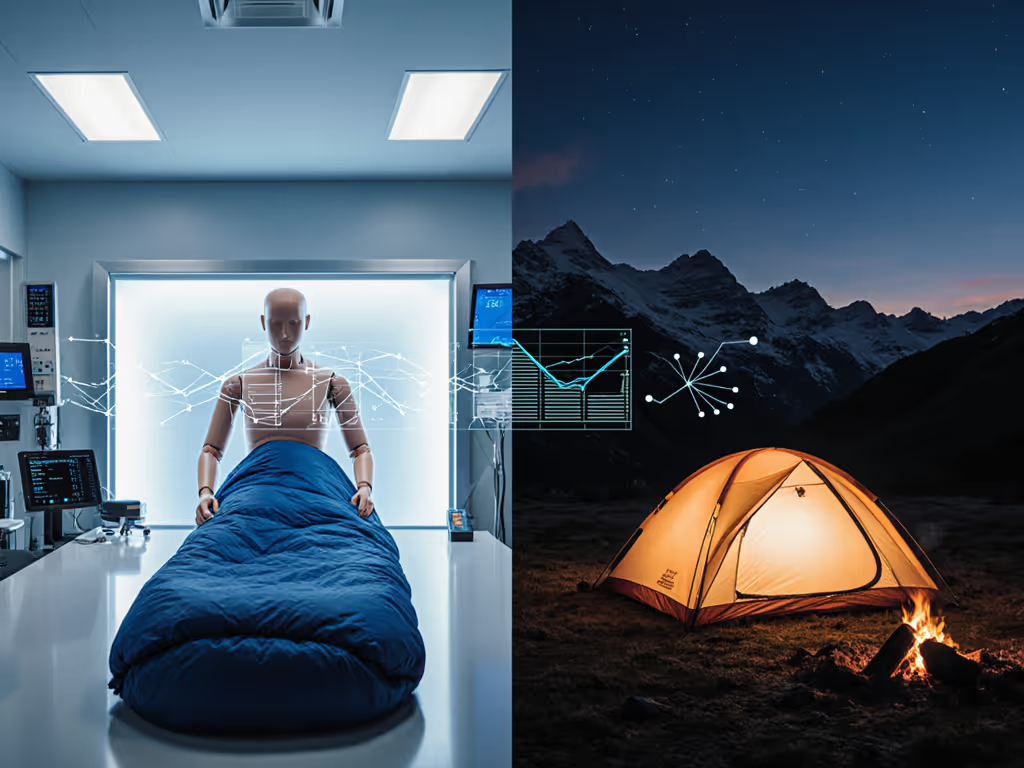
Most modern bags use EN or ISO style testing, where a heated thermal manikin in standardized base layers lies on an insulating pad inside a controlled chamber to determine "comfort" and "lower limit" temperatures.[7][10] The result is a lab rating in still, dry air on a defined pad, not on a windy alpine col or a damp coastal campsite.[7][10] For a deeper translation of lab ratings to field conditions, see how humidity steals your warmth and what to do about it.
In that chamber, the manikin doesn't toss, turn, or side-sleep; the pad doesn't deflate; humidity is stable. During a factory visit years ago, I watched one of these manikins cycle through protocols while we checked sensor drift and chamber stability. Impressive engineering, but also a reminder that these are reference conditions, not your actual campsite.
Most brands and educators then suggest adding a buffer below your expected low because of individual variation and field conditions:
- Some calculators recommend a bag 5 °C (≈9 °F) colder than the forecast low.[5]
- Others advise choosing a bag about 10 °F (~5 °C) below the coldest temp you expect, and 20 °F (~10 °C) below if you know you sleep cold.[7]
- Some camping advice echoes this, recommending a 10-15 °F buffer for real-world comfort.[6][10]
Those broad rules implicitly assume a population average offset plus some weather noise. You can do better by measuring your offset and then combining it with those buffers. Standards inform; translation delivers real sleep in real weather.
How do I calculate my personal offset from a real trip?
This is the core method. Assumptions disclosed, limitations explicit: this is a first-pass tool, not a perfect predictor, but it is much better than guessing.
Step 1: Pick a "reference night"
Choose one recent night where:
- You remember the overnight low temperature (weather station, forecast that verified, or logger).
- You used one primary bag or quilt, one main pad, and a typical shelter (e.g., double-wall tent, standard tarp, or bivy).
- You slept mostly comfortable, neither clearly cold nor sweating.
Record:
- Bag's comfort rating (if you only have a single rating, use that as an approximation).[7][10]
- Pad R-value.[5]
- Shelter type (double-wall tent, single-wall, tarp, hammock, etc.).
- Sleep clothing (thin base layers, heavy puffy, socks, hat).
Step 2: Normalize for obvious outliers
You want "typical" conditions, not corner cases.
Exclude or note separately nights where:
- Your pad failed or was wildly mismatched to the temp.
- You wore an unusually thick down jacket or multiple pants layers.
- You had extreme wind exposure (e.g., fully open tarp in a gale) or slept in a heated hut.
If all your recent nights are messy, keep them, but add notes. You can still fit a pattern over several trips.
Step 3: Estimate simple environment corrections
To keep this practical, we'll use small corrections rather than a full physics model.
Use these heuristic corrections (in °C) from that reference night:
-
Shelter correction
-
Double-wall tent: 0 °C (baseline).
-
Single-wall tent or well-pitched tarp in light wind: treat as −2 °C colder equivalent.
-
Very exposed tarp or bivy in strong wind: treat as −4 °C colder equivalent.
-
Pad correction Field experience and manufacturer guidance emphasize that an adequate pad is critical to perceived warmth.[5][10] A practical approximation:
-
If your pad R-value is about right for the temperature, use 0 °C correction.
-
If you suspect it was under-insulated (e.g., 2.0 R at freezing), treat the night as 2-4 °C colder equivalent.
-
If it felt overkill (e.g., high-R winter pad on mild nights), treat as 1-2 °C warmer equivalent.
Lab-to-field translation: For ground sleeping, many field tests cluster around: R 2-3 for nights ≳ 5 °C (40 °F), R 3-4 near 0 °C (32 °F), R 4.5-5.5 near −7 °C (20 °F), and R 6+ for colder. These bands are heuristics, not hard limits. For additional techniques to improve perceived warmth beyond ratings and R-value math, read our sleeping warm guide.
Step 4: Do the math
Now calculate your effective overnight temperature for that night:
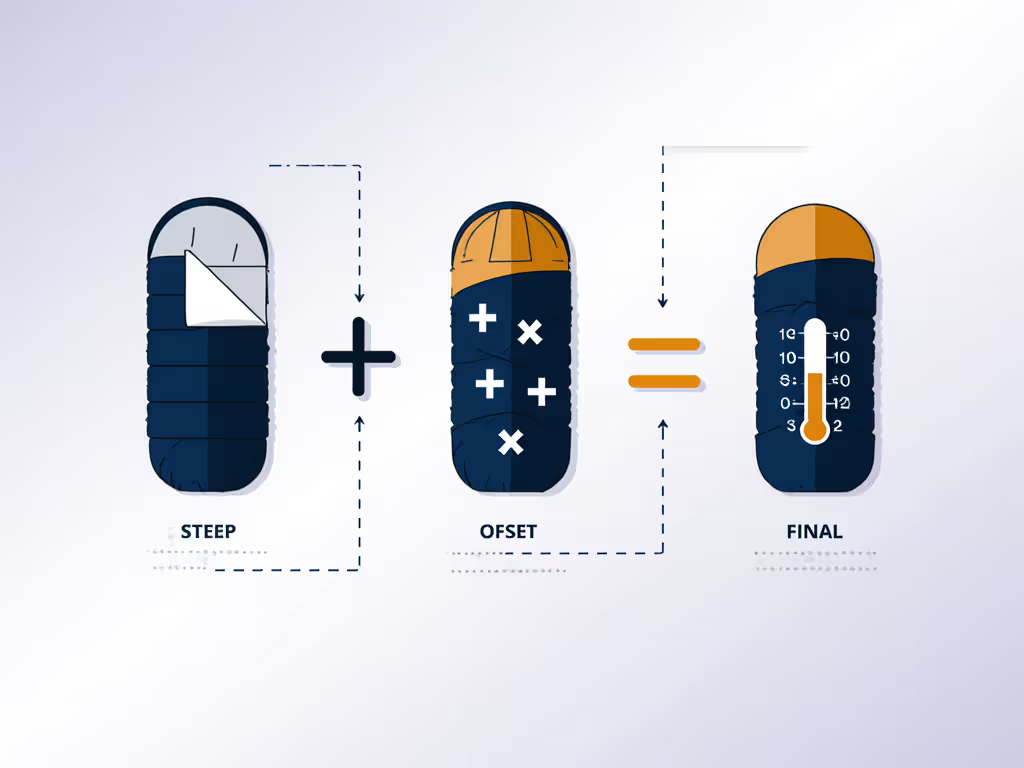
[ T_{\text{effective}} = T_{\text{air}} + C_{\text{shelter}} + C_{\text{pad}} ]
Then compute your personal offset:
[ \text{Offset} = T_{\text{comfort rating}} - T_{\text{effective}} ]
Where:
- Temperatures are in the same units (all °C or all °F).
- A positive offset = you run colder than the standard.
- A negative offset = you run warmer than the standard.
Example (in °C):
- Bag comfort rating: −3 °C
- Measured air low: 0 °C
- Double-wall tent → ( C_{\text{shelter}} = 0 °C )
- Mildly under-insulated pad → ( C_{\text{pad}} = −2 °C )
Then:
- ( T_{\text{effective}} = 0 + 0 - 2 = -2 °C )
- ( \text{Offset} = -3 - (-2) = -1 °C )
In words: you were comfortable 1 °C colder than the bag's comfort rating, so your personal offset is −1 °C (slightly warm sleeper in this setup).
Plain-language footnote: Expect a single-night estimate to be fuzzy by about ±2-3 °C; multiple nights will give you a more reliable average.
How do metabolism, body composition, and thyroid affect my offset?
The ISO/EN manikin has one "metabolism"; you do not.
Key factors that often shift your metabolic rate and camping warmth:
- Body size and composition - Larger bodies and those with more muscle usually generate more heat at rest. Higher body fat can help with body composition warmth retention by adding insulation, especially around the core.
- Sex and hormones - Many women report feeling colder at the same rating, a pattern that shows up in brand guidance noting women often need warmer bags for identical conditions.[5]
- Thyroid function - Low thyroid function can reduce basal metabolic rate, lowering heat production and effectively increasing your thyroid function sleep temperature requirement (your offset becomes more positive). This is a medical domain; if you suspect an issue, talk to a clinician, not your gear.
- Calories and hydration - Going to bed under-fed or dehydrated reduces heat output; a warm, carb-biased meal and adequate fluids can shrink an otherwise positive offset.
- Fatigue and altitude - Exhaustion and poor acclimatization can make you feel colder than your numbers suggest.
Your offset is a summary metric that quietly includes all these factors under "how your body behaves on typical trips." You do not need to model each variable, as long as your reference nights are representative, your offset already bakes them in.
How big is a "normal" personal offset?
Combining lab practice with field recommendations, most people land in a band like this:
| Sleeper type | Typical offset (°C) | Typical offset (°F) | Practical guidance |
|---|---|---|---|
| Warm sleeper | −2 to −6 | −3 to −10 | Can sometimes match bag rating or even push it a bit lower in calm conditions. |
| "Average" sleeper | −1 to +3 | −2 to +5 | Standard 5-10 °F buffer usually feels about right.[5][7][10] |
| Cold sleeper | +4 to +10 | +7 to +18 | Often needs a bag 10-20 °F warmer than the forecast low or heavier pad/clothing.[5][7] |
These ranges align with common expert advice to choose bags 5-10 °F (~3-5 °C) colder than your expected low, and up to 20 °F (~10 °C) colder if you know you sleep cold.[5][7][10] To turn those ranges into a precise number for you, use our step-by-step guide to personalizing EN comfort ratings.
Uncertainty ranges matter: a ±3 °C (≈±5 °F) error band is realistic when wind, humidity, and your own physiology fluctuate.
How do I use my offset to calculate warmth requirements for future trips?
Once you know your number, you can build a simple decision rule.
1. Adjust the bag rating by your offset
For a given bag, define a personal comfort rating:
[ T_{\text{personal comfort}} = T_{\text{bag comfort}} - \text{Offset} ]
Remember the sign convention: if your offset is +5 °C (you need it warmer), then your personal comfort rating is 5 °C higher (less cold) than the printed rating.
Example:
- Bag comfort rating: −6 °C (21 °F)
- Your offset: +4 °C (you're colder than standard)
- Personal comfort: −6 + 4 = −2 °C (28 °F)
For planning, treat this bag as a −2 °C / 28 °F bag for you.
2. Compare to your trip's expected low
Take your forecast overnight low and add a field safety buffer:
- Mild, sheltered conditions: add 2-3 °C (≈5 °F).
- Windy or uncertain forecast: add 5-6 °C (≈10 °F).
If that buffered low is warmer than your personal comfort rating and you have an adequate pad for that temperature band, you are in a reasonable comfort zone.[5][10]
If it is colder, you can:
- Step up to a warmer bag (lower comfort rating).
- Increase pad R-value (often the best warmth-per-weight upgrade).[5][10]
- Plan heavier sleep clothing or a sleeping bag liner, treating them as worth maybe 2-5 °C (3-9 °F) when used correctly (draft-free, not compressing loft).
3. Remember system synergy
A sleep system is: bag/quilt + pad + shelter + sleepwear + your body. Your offset primarily modifies the bag part, but it assumes you keep the rest roughly in the same performance class.
If, for example, you move from a double-wall tent to an airy tarp in shoulder-season wind, mentally subtract a few degrees from what your offset would normally allow, or compensate with pad/clothing upgrades.
How can I refine my offset over time?
Think of your first calculation as a prior that you update with more data.
A simple field protocol:
- Log every trip night for one season: bag, pad R, shelter, clothing, forecast vs observed low, and a simple comfort score (cold / fine / warm).
- For each "fine" night, re-run the offset calculation above.
- Average those offsets for similar setups (e.g., 3-season kit vs winter kit).
- Note when changes in body weight, fitness, or health seem to shift your average.
Over a handful of trips, you will build a personal data set that turns vague advice into a clear number for your physiology and your kit.
Related Articles